Tatra Tarn
/1
- Tatra Tarn
- Tatranské Pleso
- 1983
- oil on pressboard
- 35 × 65 cm
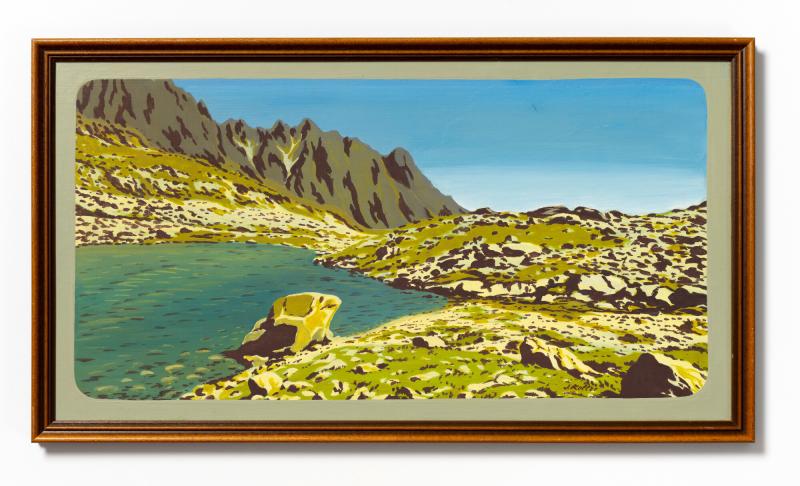
“Tatranské pleso” (1983) is a typical example of the Július Koller’s mostly acrylic paintings executed on hardboard and intended for sale through the state enterprise Dielo. Since Koller did not participate in state commissions despite being an academically trained painter, the sale of his paintings through this state monopoly provided the artist with his basic livelihood from 1968 to 1989. Dozens—if not hundreds—of similar motifs were produced, painted exclusively after printed reproductions or postcards depicting popular tourist attractions in Czechoslovakia. He always selected his motifs with sensitivity and often embedded hidden signs and meanings within them. These “bread-and-butter paintings” were hence not just a means of subsistence but an integral component of his artistic practice.
As part of the anti-happening “Akad. Mal.”, the artist had himself photographed on the balcony of his apartment with these paintings, of which he kept detailed documentation. “Tatranské pleso” was a sought-after motif due to its popularity among mountain vacationers. It is also loosely associated with his fictional gallery project, “Gallery Ganek (U.F.O.),” which he initiated at the beginning of the 1980s. The painting style is unmistakable: at once matter-of-fact, unpretentious, and popular. Koller was a consistent critic of the exclusivity of avant-garde modernism as well as of socialist realism, and he refused to conform to either. The result was a body of wall paintings intended for domestic interiors and for a broad spectrum of art lovers and alpine tourism enthusiasts. D.G.
As part of the anti-happening “Akad. Mal.”, the artist had himself photographed on the balcony of his apartment with these paintings, of which he kept detailed documentation. “Tatranské pleso” was a sought-after motif due to its popularity among mountain vacationers. It is also loosely associated with his fictional gallery project, “Gallery Ganek (U.F.O.),” which he initiated at the beginning of the 1980s. The painting style is unmistakable: at once matter-of-fact, unpretentious, and popular. Koller was a consistent critic of the exclusivity of avant-garde modernism as well as of socialist realism, and he refused to conform to either. The result was a body of wall paintings intended for domestic interiors and for a broad spectrum of art lovers and alpine tourism enthusiasts. D.G.