Lia Perjovschi
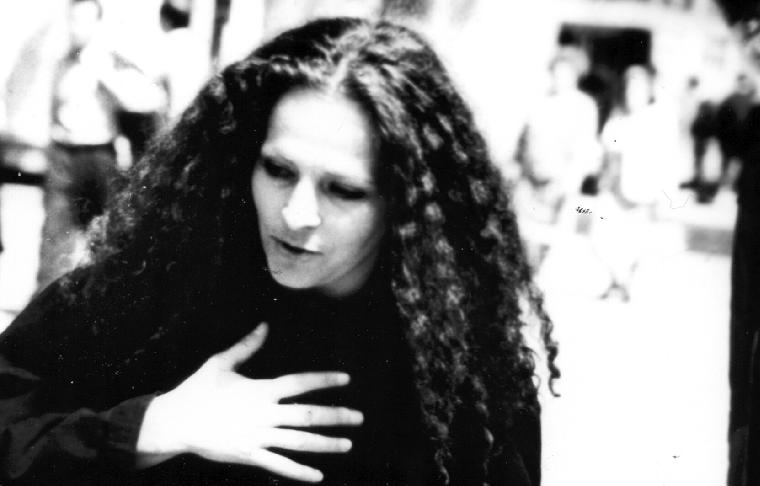
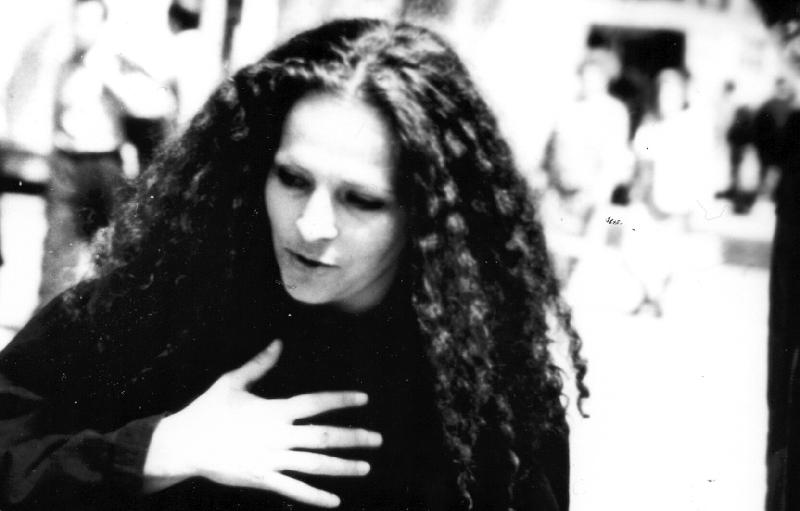
What attributes comprise the “will of a tiger”? Fierce instinct, intellectual strength, and a powerful, unyielding drive, along with the ability to tenaciously overcome obstacles through the sheer force of determined resolution. Lia Perjovschi possesses all these qualities. Follow her history from youth to maturity and one encounters a woman with fierce determination to create, coupled with the courage to be true to her thoughts and ideas. Key to Lia’s steadfast strength is her unshakeable insistence on independence, together with her capacious ability to laugh at herself and the world. Lia began
her artistic career as part of the Romanian avant-garde underground that existed before the country burst open in the Romanian revolution December 16, 1989. Even before the revolution, Lia was precocious, as one of the earliest Romanian artists to work in conceptual and performance art. Four years after the revolution, she titled one of her most powerful performances I’m Fighting for my Right to be Different (1993). For this compelling action, she created an “alter ego” in the form of a life-sized ragdoll that was about her height. She then interacted with her doppelgänger. Initially, Lia’s interactions with the doll were gentle, but as the performance progressed, she escalated into aggressive behavior, fighting with the doll, hitting it against the walls, and throwing it at the people watching. As she has explained, she “always copied the position in which the doll fell,” and she “apologized to those who were hit by it when they did not move. ” She also threw the doll down a flight of stairs, generally abusing the formerly cherished toy. Lia’s performance simultaneously represented a symbolic, metaphorical, genuine, and courageous struggle with herself. The title of the performance summed up Lia’s lifetime fight for protecting and maintaining her difference.Lia’s emotionally moving performance took place during Romania’s transition from a harsh, totalitarian, communist state under dictator Nicolae Ceaușescu. Even after the revolution, this period was characterized by severe economic hardship, daily power outages, food rationing, limited hot water, strict travel bans, and state control. Despite its official status as a sovereign independent socialist republic, which had previously distanced itself from the Soviet Union’s direct control, the country slowly transitioned into its newly found independence. Thirty-six years later it must still be acknowledged that Lia Perjovschi’s performance testifies to the fact that she conquered the negativity of the past and won the battle in the present.Lia was born in 1961. Diminutive in stature, Lia has an indomitable artistic vision, a strategic acumen, and a child-like playfulness that shields her remarkable sophistication, as well as intellectual and analytical view of art and the world. Given her expansive imagination, character, and engagement with the world in general, it should come as no surprise that one of her many artistic projects is an ongoing collection of a variety of globes, begun in 1990 and continued to today as a recycled collection in her Museum of Knowledge. They vary from large blowup rubber ballon globes to tiny marble-size globes, and from globes in many materials to dozens of other manifestations that include a seeming endless variety: globes printed on playing cards; globes on magazine covers; globe trinkets; globe images of the planet; globes on pillows and hats, all objects related to the global world of the things of life that record the diversity of human invention and imagination. The globe collection is just one of Lia’s many series attesting to her boundless inquisitiveness and contagious sense of irony regarding human behavior and the acquisition of “things.”Parallel to her collections, Lia also works in a host of media, from drawing, painting, and performance to photography. These various means and visualizations demonstrate her pursuit of different methods for organizing and conveying the massive amounts of information that she continually collects. One particularly fascinating series is her Mind Maps (Diagrams). Initially begun in 1999, she continues this series into the present. As Lia has explained: The Diagrams are summary notations of interdisciplinary readings from magazines, books, (dictionaries, encyclopedias), Internet (Wikipedia) non-fiction sources (new research about the body, earth, universe, art, culture, science, knowledge today). Mind Maps are diagrams with images that help identify the subject more quickly. I made the first rhizomatic notations in 1999 trying to make a diagram to describe the archive for an application at the Swiss Arts Council, Pro Helvetia. I liked it because I could stay on a single page of paper, with the possibility of adding other information on the subject over time. I keep writing like this. In some diagrams/mind maps the information is organized more interestingly than in others. Someone notices that they are for a slow viewer. I don't expect anyone to read it all, besides me. Although some do. I underline key words to make it easier for the viewer. It is more about the complexity of knowledge and a picture of our accumulation.These works are drawings, but are primarily handwritten words, organized in patterns that reveal interconnections in the universe of information currently accessible to the world. Lia’s diagrams emerge from her “seed concepts,” then spin out in fascinating shapes comprised of more words that also can morph into various short texts. The Mind Maps (Diagrams) require one to pay close attention to the language that Lia chooses to convey the associations that she anticipates viewers of will make, leaving those ideas unconstrained by dogma or direction. Some scholars have observed that Lia’s drawn texts are a way to participate in her visual and textual process itself. I agree but wish them luck. For Lia’s thinking process is personal, as well as intricate and elaborate in terms of the associations she makes in her written texts. All this represents her effort to communicate with the public. Indeed, Lia’s combination of mental, theoretical, and visual work represents an artistic practice that is seductive, challenging, distinctive, and unique. Thinking further about the Mind Maps (Diagrams), some authors have compared them to “starbursts.” While this comparison is poetic, it may not be quite accurate. For Lia’s drawings fundamentally represent her cerebral focus and deep consideration of how a text (or words in themselves) relate to images while simultaneously being images and not just text. As such, Lia’s textual images are substantiated by rigorous thinking about language and the terms in which visual things can be delivered in as language in themselves. When displayed as clever meandering pictorial texts that require close study and examination, Lia’s text works offer a seed of information that does not necessarily provide the promise of comprehension. For what viewers are simultaneously challenged to consider are words as images related to her selected themes. For example, in one of her drawings, the terms “Modernity” and “Postmodernity” spin out at the bottom where they meet the word “Reality?” What many may overlook is that her question mark asserts her sharp-witted shift from the presumed actual to a questionable possible. Such subtle maneuvers affirm Lia’s discriminating abstract thinking and intellectual depth. Raluca Oancea is a particularly insightful interpreter of Lia’s General Timeline: From Dinosaurs to Google Going China (1997-2006). Lia further points out that the timeline is “from the discovery of fire to today 2025 (“general culture, discoveries, inventions, WW1, WW2, Cold War, 911, Today's Wars, Terrorism...and anti-art…). ” Oancea described Lia’s drawings as “seeds.” Adding to Oancea’s insight, I suggest that those “seeds” are formidable intellectual challenges, sparks that are interrelated correspondences throughout Lia’s oeuvre. Oancea also praised Lia’s 2022 site-specific installation Colours. A Deconstructed Painting, writing: After half a life spent constrained by the colors of communism, by shades of gray, after a pandemic in which our everyday was constantly mediated by screens, filters, and RGB codes, the artist’s need to reconnect to the green of leaves, to the blood-red of berries, proves to be a necessary treatment. calls for a return to color in all its complexity and immateriality, as wavelength, pigment, and affect…Lia Perjovschi’s art is poetry. Again, I concur with Oancea. For in this work, Lia invites viewers to mentally manage the extensive assortment of media often used in an artist’s practice, from painting, photography, and textile objects to mixed media installations. All options that may be embedded in larger spatial compositions in the form of the various elements she uses to deconstruct a painting while producing it. Simultaneity and deconstruction are the essence of Lia’s practice.Following a visual narrative of the development her art over time, Colours bespeaks Lia’s continued examination of the range of perceptions and the intricacy of her ability to produce symbolical systems in the process of creating the visual meanings of her art. Lia’s work also demonstrates how subjectively an artist can create connections among the specter of light and samples of various degrees, shades, and meanings of colours. Lia builds and juxtaposes a variety of visual media that are something like shadows of her embodied self. One must carefully consider the entanglement of time recorded and theorized in Lia’s own commentary:30 years in black/white and grey. The colours were rare, fragmentary – during Communism, the colours of darkness, powerlessness, immobility, sleep. Followed by 30 ‘colourful’ years in the crazy dynamics of neoliberalism, when the colours sometimes become loud, the black & white and grey now being sanctuaries of calm, pause and focus.An exhibition of deconstructed paintings. Without balance. Subjects in context, scattered elements. An ‘explosion’ of colours and samples, that influence, manipulate, hypnotize.Symbolically speaking, all colours are both positive and negative. When I was considering the subject of colours, it was before the war on Ukraine. I was thinking about something optimistic, that would bring a sense of hope, especially after the two years of the pandemic. Nevertheless, the war changes everything… In addition to the above, Lia continues to pursue the following undertakings: International Archive for Contemporary Art 1990–todayThe Center For Art Analysis 1999–todayTimeline 1997–todayDiagrams/Mind Maps 1999–todayKnowledge Museum Project 1999–todayLia began her project Subjective Art History: From Modernism to present day Art and its Context in the 1990s. She opened with the first historical photograph taken by Joseph Nicéphore Niépce (1765–1833). She ended this direction of her work in 2004 in a 35-page publication/newspaper. Since then, in 1997 Lia added two more issues, a digest of texts, and images of contemporary art from all over the planet, having founded and coordinated the CAA/CAA: The Contemporary Art Archive/Center for Art Analysis. This is another one of her independent “works in progress” that she began in 1985 under different names. Lia created this history to recuperate decades of missing information on contemporary Romanian art, absences that resulted in Romanian artists’ isolation during Nicolae Ceaușescu’s strict communist regime. That rule came to an end on Christmas day, December 25, 1989, when the Romanian Revolution overthrew and executed Ceaușescu and his wife Elena by firing squad, bringing forty-two years of communist rule in the country to an end. When one puts this historical moment in perspective, we must consider the first twenty-eight years of Lia’s life were lived under Ceaușescu’s regime. K.S.
more